Showing posts with label Solar Eclipse. Show all posts

Thursday, April 11, 2024

Capturing a Total Solar Eclipse

I was fortunate enough to experience the 2024 Total Solar Eclipse from Carmel, Indiana. While I was able to view the eclipse through my eclipse glasses, I also brought various recording devices to capture my surroundings from multiple perspectives. This blog entry provides some information about my setup.

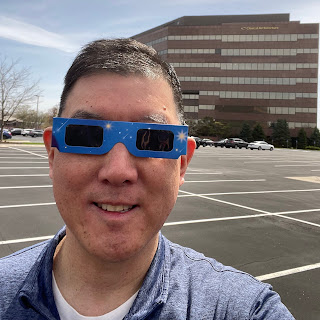
Location, Location, Location. The first consideration, aside from being in the path of totality, was to determine the exact location from where I’d view the eclipse. I decided that in addition to directly recording the sun itself, it would be interesting to record the office building where I work—right before, during, and right after totality. From the parking lot (pictured above), I was able to get a good angle of the building, free from obstruction, as well as an unobstructed view of the sun.

Timing. For most people, an approximate time for the start and end or totality would suffice. Most eclipse viewers simply need to arrive before totality and might snap a few photos and videos to commemorate the event. I was slightly more constrained because I needed to ensure that I had sufficient storage space on my memory cards as well as battery life to capture my intended footage. To determine the precise start and end of the partial and total eclipse, I used the US Navy Solar Eclipse Computer. I grabbed GPS coordinates from Google Maps and entered them into the Solar Eclipse Computer but had to truncate them after 4 decimal places. I made sure to arrive shortly after the beginning of the partial eclipse which would give me an hour to get situated, look around, and set up all my equipment to prepare for totality.

GoPro. One of my recording devices was my GoPro HERO7 Black which I simply affixed to a 3D printed mount and placed on the hood of my rental car since it was one of the only objects above ground level. The purpose of the GoPro was to record a video of the office building and produce a timelapse video immediately before, during, and immediately after the 3.5 minutes of totality. I wasn’t able to attach the mount to anything, and despite there being a slight breeze, I was fairly confident that it would not move around during recording. Given my familiarity with my GoPro’s battery life, I began recording about 10 minutes before the onset of totality, as I was confident that I’d have more than enough RAM and battery life to capture all of totality and several minutes afterward.

Drone. My 2nd recording device was a DJI Mavic Mini. Its purpose was also to obtain a timelapse of the building but from a higher perspective. Approximately 7 or 8 minutes before totality, I flew the drone to 18 meters (59 feet) altitude, according to the flight data, and started recording. I simply allowed the drone to hover for the entire duration. While the drone stayed put for the most part, the 10x timelapse shows what looks like noticeable movement of the drone in all 3 axes which gave the building a “rubbery” appearance. I don’t know how much of this movement was due to the wind. In any case, I was happy with my timing, as the battery lasted through totality and plenty of time thereafter.

Camcorder. My 3rd recording device was a Canon VIXIA HF M301 camcorder with 15x optical zoom capabilities. Along with my eclipse glasses came a camera filter which was probably intended to be used with mobile phones, but the diameter of the filter was sufficient to cover the entirety of the camcorder lens. I used 2 pieces of clear tape to attach the filter to the camcorder so that it fully covered lens. I mounted the camcorder to a portable tripod and placed the tripod on a folding chair, mainly for the purpose of elevating it off the pavement of the parking lot so it was easier for me to make adjustments. Given that I had zoomed all the way to 15x, I discovered that I was only able to capture the sun for a few minutes at a time before it moved off frame. Therefore, I had to keep repositioning the camcorder before, during, and after totality. This meant that I was unable to capture a continuous uninterrupted video of the eclipse. Maybe next time I’ll consider investing in a solar photography tracking mount, but I was mostly satisfied with the results that I got without one. I noticed that when the sun was closer to the edges of the frame, the camcorder had difficulty auto-focusing on the sun, but that was not surprising.

The one obvious missing recording device was my Canon R6 full frame mirrorless camera which I alluded to here. I expected to have my hands full with all the recording devices above, and the addition of my R6 camera and another tripod would have added significantly to my luggage. Therefore, I made the difficult but practical decision to leave it at home. Maybe I’ll bring my “big” camera to a future solar eclipse. Overall, I was happy with the amount of planning that I put into this momentous occasion, and I was blessed with fairly clear skies and good weather, all of which amounted to an unforgettable event. You can enjoy my eclipse video here and below:

Sunday, March 24, 2024

Safely Viewing the Total Solar Eclipse

On April 8, 2024, a total solar eclipse will pass over portions of Mexico, the U.S., and Canada. While a path of totality that traverses San Antonio, Austin, Dallas, Little Rock, Indianapolis, Buffalo, most locations in the U.S. will feature at least a 50% eclipse of the sun. That means a lot of Americans will be trying to experience the eclipse, whether it be by viewing it directly and/or taking photos or videos of the eclipse as I did in August 2017.

The main focus of eclipse viewing is to do it safely. In short, you should never look directly at the sun because it can damage your eyes. However, with the right eclipse glasses and the proper use of them, you can safely watch the eclipse. Read Safe Viewing of Solar Eclipses and Watching a Solar Eclipse Without the Right Filters Can Cause Eye Damage for additional information.

If you have concluded that you will buy solar eclipse glasses, and if you’ve paid attention to the references above, you know not to trust just any pair of eclipse glasses. The American Astronomical Society has a list of vetted suppliers. Make your your eclipse glasses are made by a supplier on this list.

Wednesday, August 23, 2017

Capturing a Partial Solar Eclipse

The 2017 Eclipse Across America took place a couple days ago on August 21, 2017. The approximately 70-mile wide path of totality extended from coast to coast, starting in Oregon and finishing its trek across America in South Carolina. Although my home in Los Angeles was not in the path of totality, nor did I travel to the path of totality, I still planned to capture the event. Here are details of the partial eclipse from the vantage point of my home in Los Angeles:


The important information for me to know was that the maximum eclipse was calculated to occur at 17:20:51 UT (10:20:51 AM Pacific time) with 62.1% obscuration. For some reason, I was not very interested in getting solar shades to look directly at the sun. I guess I prefer to capture events so I can relive them later. So I did 3 things...

First, I recorded a timelapse series with my GoPro HERO3+ which, according to this article, was deemed safe to use in directly photographing the sun, without the need for special filters. My setup was simple and involved mounting the GoPro on a tripod using a standard GoPro mount with 1/4" thread converter.


I pointed it at the sun and took 1 photo every 10 seconds. With a fully charged battery, I started the timelapse at 9:14 AM Pacific and ended 778 frames later at 11:23 AM Pacific when my battery died. Fortunately I had enough battery power to capture the maximum partial eclipse. I edited the photos in Lightroom by cropping the original 4000x3000 pixel images to 1920x1080, straightening the crop angle, and applying some other minor adjustments such as tweaks to highlights, shadows, and curves. I composed the video in Final Cut Pro X in 1080p 60fps. Each image was set to display for 2 frames (i.e., 2 frames divided by 60 frames/second = 1/30 second), so my final speed was 300x. I was surprised that even during maximum eclipse with 62.1% obscuration, the sun appeared to be circular in shape (see video below). I was not expecting to see a clean crescent, but I thought at least the sun would not appear to be a nice round circle. I suspect that this was due to a combination of the overwhelming brightness of the sun combined with usage of a low-resolution wide-angle GoPro.

Second, I read about binocular projections and decided to try making one by myself. I secured my binoculars to a tripod using rubber bands and pointed it at the sun—of course, without looking through the binoculars. After all, everybody knows that you're not supposed to look directly at the sun, right? I covered one of the lenses to avoid generating a duplicate image. I then placed a paper notepad on the ground, cardboard side up, onto which I projected the (monocular) image. For me, the trick in getting a better visualization of the eclipse was to create enough shade around the lens, and I did so by simply tearing a hole in a piece of paper and threading the the binocular lenses through the hole. My makeshift binocular projection looked like this:


As you can see, you get a much larger projection than with a pinhole camera, and naturally I was inclined to take photos of the binocular projection.

Third, I played around with pinhole projections. Instead of creating a typical pinhole-on-a-cereal-box viewer, I decided to play around with various objects such as a colander and strainer. I found the colander to be too large and unwieldy for me to cover its edges with paper to visualize the crescent projections. The strainer worked better due to its size, but with its relatively large holes (which I did not measure but estimate to be 3-4mm in diameter), the projections were blurry. Next time I'll try to prepare in advance some objects that have smaller holes. Nevertheless, I had fun searching for "natural" pinhole projections such as crescent formations through tree leaves and the tiny holes in our living room blinds.

A video with footage of the timelapse, binocular projection, and pinhole projections is available here:


Now that I have a little bit of experience with capturing a solar eclipse, I should be ready for the next American total eclipse on April 8, 2024. Hopefully next time I'll have a chance to travel to the path of totality.

Sunday, June 11, 2017

Total Solar Eclipse


There will be a total solar eclipse on August 21, 2017, and the moon's shadow will run west to east directly over the United States. If you like astronomy and/or photography, this is an event that you may not want to miss. To aid in your planning, here are some web sites that you might find useful:

Xavier Jubier's 2017 Total Eclipse Interactive Google Map. This web site provides detailed data about when the eclipse will start and end, depending on where you are. It also provides a visual indicator of the areas that will experience a total solar eclipse, as opposed to a partial solar eclipse.

Eclipse2017.org. This web site has a date countdown, offers an option to purchase eclipse glasses, and provides much more narrative descriptions of how to safely view the eclipse.

Preparing for the 2017 Total Solar Eclipse. This blog provides excellent considerations for photographing the eclipse, most of which is contained in an embedded YouTube video.

And just for fun, if you want to fly along with the moon's shadow for a virtual sneak peek of the eclipse, check out this video.

Finally, if you will be under the path of totality and plan to photograph the eclipse, you can be one of more than 1,000 photographers who can submit images to the Eclipse Megamovie Project so those media assets can be stitched together to create a continuous view of the eclipse as it passes over the United States.

Happy viewing!