Thursday, January 2, 2020

Drone Registration for Recreational Flyers


Hoo wah! Daddy received a DJI Mavic Mini for Christmas. It’s my first drone, and I thought I’d share a few thoughts related to drone registration for recreational flyers. Since commercially available drones are still relatively new to the public and are growing in popularity, congressional legislation and Federal Aviation Administration (FAA) regulations are still evolving. In this post, I share my current knowledge of federal requirements based on my cursory research. As always, you should do your own research and stay informed about federal laws and regulations as well as local restrictions before piloting a drone.

KEY POINTS

There are 3 drone weight classes that determine if and how you register your drone with the government:
  1. 0.55 pounds (250 g) or less: exempt from registration
  2. > 0.55 pounds (250 g) and < 55 pounds (25 kg): register online or by paper
  3. 55 pounds (25 kg) or more: register by paper
According to Know Before You Fly, if you meet the criteria and fail to register your done, you may be subject to civil penalties of up to $27,500 and/or criminal penalties of up to $250,000 and/or other judicial action.

If you are a recreational flyer of a drone that is < 55 pounds, you may fly under either FAA’s Small UAS Rule (14 CFR Part 107) or Section 44809 of the FAA Reauthorization Act of 2018. If you are not sure what kind of pilot you are, a User Identification Tool will help you figure it out.

The rules governing small UAS under Part 107 UAS Operations include:
  • The aircraft must be registered if over 0.55 lbs;
  • Must fly only in uncontrolled airspace;
  • Must keep the aircraft in sight (visual line-of-sight);
  • Must fly under 400 feet;
  • Must fly during the day;
  • Must fly at or below 100 mph;
  • Must yield right of way to manned aircraft;
  • Must NOT fly over people;
  • Must NOT operate from a moving vehicle.
Section 44809 of the FAA Reauthorization Act of 2018 addresses an exception for limited recreational operations of unmanned aircraft. All of the following must be satisfied:
  1. The aircraft is flown strictly for recreational purposes.
  2. The aircraft is operated in accordance with or within the programming of a community-based organization's set of safety guidelines that are developed in coordination with the Federal Aviation Administration.
  3. The aircraft is flown within the visual line of sight of the person operating the aircraft or a visual observer co-located and in direct communication with the operator.
  4. The aircraft is operated in a manner that does not interfere with and gives way to any manned aircraft.
  5. In Class B, Class C, or Class D airspace or within the lateral boundaries of the surface area of Class E airspace designated for an airport, the operator obtains prior authorization from the Administrator or designee before operating and complies with all airspace restrictions and prohibitions.
  6. In Class G airspace, the aircraft is flown from the surface to not more than 400 feet above ground level and complies with all airspace restrictions and prohibitions.
  7. The operator has passed an aeronautical knowledge and safety test described in subsection (g) and maintains proof of test passage to be made available to the Administrator or law enforcement upon request.
  8. The aircraft is registered and marked in accordance with chapter 441 of this title and proof of registration is made available to the Administrator or a designee of the Administrator or law enforcement upon request.
Fortunately, my DJI Mavic Mini is 249 grams (that is the aircraft takeoff weight which includes battery, propellers, and a microSD card) so I didn’t need to register it. However, since I took the effort to research the topic, here’s some background information about laws and regulations that you might find helpful if your drone weighs more than 250 grams.

LEGISLATION

Let me begin by highlighting a few aspects of federal legislation that was passed by congress and enacted into federal law.

The FAA Modernization and Reform Act of 2012 (FMRA) became public law on 2/14/2012. The most pertinent language related to drones is as follows: “Subtitle B: Unmanned Aircraft Systems - (Sec. 332) Requires the Secretary to develop a plan to accelerate safely the integration by September 30, 2015, of civil unmanned aircraft systems (UASes, or drones) into the national airspace system.”

The FAA Extension, Safety, and Security Act of 2016 (FESSA) became public law on 7/15/2016. Under Subtitle B--UAS Safety, “(Sec. 2202) The FAA shall convene industry stakeholders to develop, and report to Congress on, consensus standards for remotely identifying operators and owners of unmanned aircraft (drones).” Additionally, “(Sec. 2208) The FAA, in coordination with the National Aeronautics and Space Administration (NASA), shall continue development of a research plan for unmanned aircraft traffic management development and deployment… The FAA, in coordination with NASA, the Drone Advisory Committee, the FAA research advisory committee, and unmanned aircraft industry representatives, shall establish an unmanned aircraft traffic management system pilot program.”

The H.R.2810 - National Defense Authorization Act for Fiscal Year 2018 became public law on 12/12/2017. According to this website, this law reinstated hobbyist registration in that it “reverses the decision in Taylor v. Huerta (856 F.3d 1089 (D.C. Cir. 2017)) in which the D.C. Circuit found that requiring hobbyists to register their drones was prohibited under Section 336 of the FAA Modernization and Reform Act of 2012.” It also gives “the Department of Defense (DOD) the authority to identify, track, and use ‘reasonable force’ to destroy drones near any DOD ‘covered facility or asset.’”

The FAA Reauthorization Act of 2018 became public law on 10/05/2018. There were several changes under Subtitle B--Unmanned Aircraft Systems. “DOT shall develop a comprehensive plan to safely accelerate the integration of civil unmanned aircraft systems into the national airspace system and shall make available a five-year roadmap for the introduction of civil unmanned aircraft systems into the national airspace system.” Additionally, “(Sec. 346) DOT shall issue guidance regarding the operation of drone to streamline and expedite the process for the issuance of a certificate or waiver, facilitate the capability of public agencies to develop and use test ranges, and provide guidance of an agency's responsibilities when operating a drone without a civil airworthiness certificate issued by the FAA. The FAA may issue guidance regarding the use of public actively tethered unmanned aircraft systems subject to specified requirements.”

REGULATIONS

Next let’s look at some regulations by the FAA which is an operating mode of the U.S. Department of Transportation.

Registration and Marking Requirements for Small Unmanned Aircraft is an interim final rule by the FAA that was effective December 21, 2015. It “provides an alternative, streamlined and simple, web-based aircraft registration process for the registration of small unmanned aircraft, including small unmanned aircraft operated as model aircraft, to facilitate compliance with the statutory requirement that all aircraft register prior to operation. It also provides a simpler method for marking small unmanned aircraft that is more appropriate for these aircraft.”

Operation of Small Unmanned Aircraft Systems over People is a proposed rule that was published by the FAA on 2/13/2019. It “would allow operations of small unmanned aircraft over people in certain conditions and operations of small UAS at night without obtaining a waiver. It would also require remote pilots in command to present their remote pilot in command certificate as well as identification to certain Federal, State, or local officials, upon request, and proposes to amend the knowledge testing requirements in the rules that apply to small UAS operations to require training every 24 calendar months.”

Hot off the press, Remote Identification of Unmanned Aircraft Systems is a proposed rule that was published by the FAA on 12/31/2019. It “would require the remote identification of unmanned aircraft systems.” Currently drones that are heavier than 250 grams require physical labeling so a drone that falls out of the sky could be identified, along with its owner. A discussion of this proposed rule is available on an NPR segment of All Things Considered.

SUMMARY

Laws and regulations about recreational drone use (all well as commercial done use which is an entirely different topic) will surely continue to evolve. Make sure you stay current will all the latest requirements to make sure that both you and your drone are compliant with all the laws and regulations. For more information about drone registration, be sure to visit FAA - Unmanned Aircraft Systems (UAS) and FAADroneZone. Have fun flying your drone and above all, be safe!

Monday, December 30, 2019

Outsmarting Your GPS

On December 26, 2019, our family attempted to drive from Los Angeles to Las Vegas via Interstate 15 which is the shortest distance and requires driving over 2 mountain ranges. We are very familiar with the drive because we’ve done it so many times. Shortly after leaving Los Angeles County, we connect with I-15 North and soon begin the climb up the Cajon Pass which is situated between the San Bernardino Mountains and the San Gabriel Mountains and has a peak elevation of 3,776 feet. After clearing the Cajon Pass, I-15 North winds through Hesperia, Victorville, Barstow, and Baker. The second major climb along I-15 North takes us over Mountain Pass which in a desert region about 15 miles from the Nevada border and has a peak elevation of 4,730 feet. After that, it’s the final stretch to Primm and then Las Vegas. See the following illustration for an overview of the route.


Here are closeups of Cajon Pass and Mountain Pass (click any image to enlarge):


There were a number of factors that led to tactical errors on the day of our fateful journey. First, we felt comfortable navigating to and from Las Vegas as described above. Second, we heard that there may be snow in the mountains, but we assumed that it would be at higher elevations where people go to ski. Third, and this is the main point of the blog, we blindly and faithfully followed our GPS. To make a long story short, we got trapped between the Cajon Pass and Mountain Pass due to snowstorms and icy roads resulting in closure of I-15. Because many other motorists were also trapped, there were no hotel vacancies so we spent the night in our cars. For more of the gory details, see this video:


Let me focus on a sequence of events that contributed to us getting a bad recommendation from our GPS (Waze). First, we knew there were on-and-off closures of I-15 that day. In fact, our first attempt to traverse the Cajon Pass was thwarted by a road closure. We decided to drive home, but at 2:21 PM, I-15 North was re-opened.


Stubbornly, we decided to make a second attempt. After all, we had reservations for our hotel and a show. Caltrans laid gravel on the road to improve traction, and we got over the Cajon Pass without incident. As of 2:55 PM, I-15 at Mountain Pass was open, but we were still a couple hours away from Mountain Pass.


Snow continued falling, the temperature kept dropping, and Mountain Pass was closed in both directions at 4:00 PM.


Meanwhile, Waze was recommending that we continue on I-15 North and did NOT force us onto a viable alternate route. This screenshot is from 4:04 PM, but Waze kept making the same recommendation for the next several hours.


Mountain Pass was not re-opened until the next morning after it had stopped snowing. This meant that motorists had to either stay on I-15 in a standstill, take an alternate route through open roads, or retire for the evening. We chose the latter, which meant spending the night in our cars.

I’d like to emphasize that this is not so much a criticism of Waze which I think is a really fantastic GPS application. It is more of a reminder for all of us to use technology as an aid but not to be fully dependent on it without thinking things through. Technology may have limitations, and it appears that even though Caltrans was tweeting updates about road closures, perhaps that information was not made available to Waze in a timely manner. In any case, it can be helpful to check multiple sources of information about traffic, road conditions, weather reports, etc. to get you to your final destination in the quickest and safest manner. Sometimes that means you have to outsmart your GPS.

Monday, December 23, 2019

Lee Family 2019 Year In Review


Our Lee Family 2019 Year In Review is now available, with prior editions available here. Depending on the device you are using, you might be prompted by Dropbox to sign in, download the mobile app, or continue to the website—you can simply select the option to continue.

As usual, our home movies are available on Victor’s YouTube channel.

Thursday, December 12, 2019

Costco.com Price Adjustment

Recently I purchased an item from Costco.com, only to discover 2 days later that the item was offered for $15 less due to holiday promotional pricing. Fortunately, the Costco Customer Service website makes it easy to request a price adjustment. According to the terms, “Costco.com will gladly issue a credit for the difference between the price you paid and the promotional price, if your purchase was made online at Costco.com and was within 30 days prior to the change in price.”

When I submitted my request, I was asked for my Costco membership number, order number, the price I paid, the promotional price of the item, and some basic contact information. When my item shipped, I was charged the original full price. One day later, I received a refund notification from Costco.


Not once did I have to explain my situation or even make a phone call. I love consumer-friendly policies like this, and I also love it when technology works. Happy holidays everyone!

Tuesday, November 26, 2019

UberX at LAX

I travel frequently for business, and I usually take Uber to and from Los Angeles International Airport (LAX). For many years, I’ve been able to summon an UberX car for curbside pickup from any of several ride sharing zones distributed throughout the airport. However, starting October 29, 2019, UberX pickups at LAX were transitioned to a new location called LAX-it. Note that Uber Black and Uber Black SUV continue to pick up passengers curbside at the terminals.

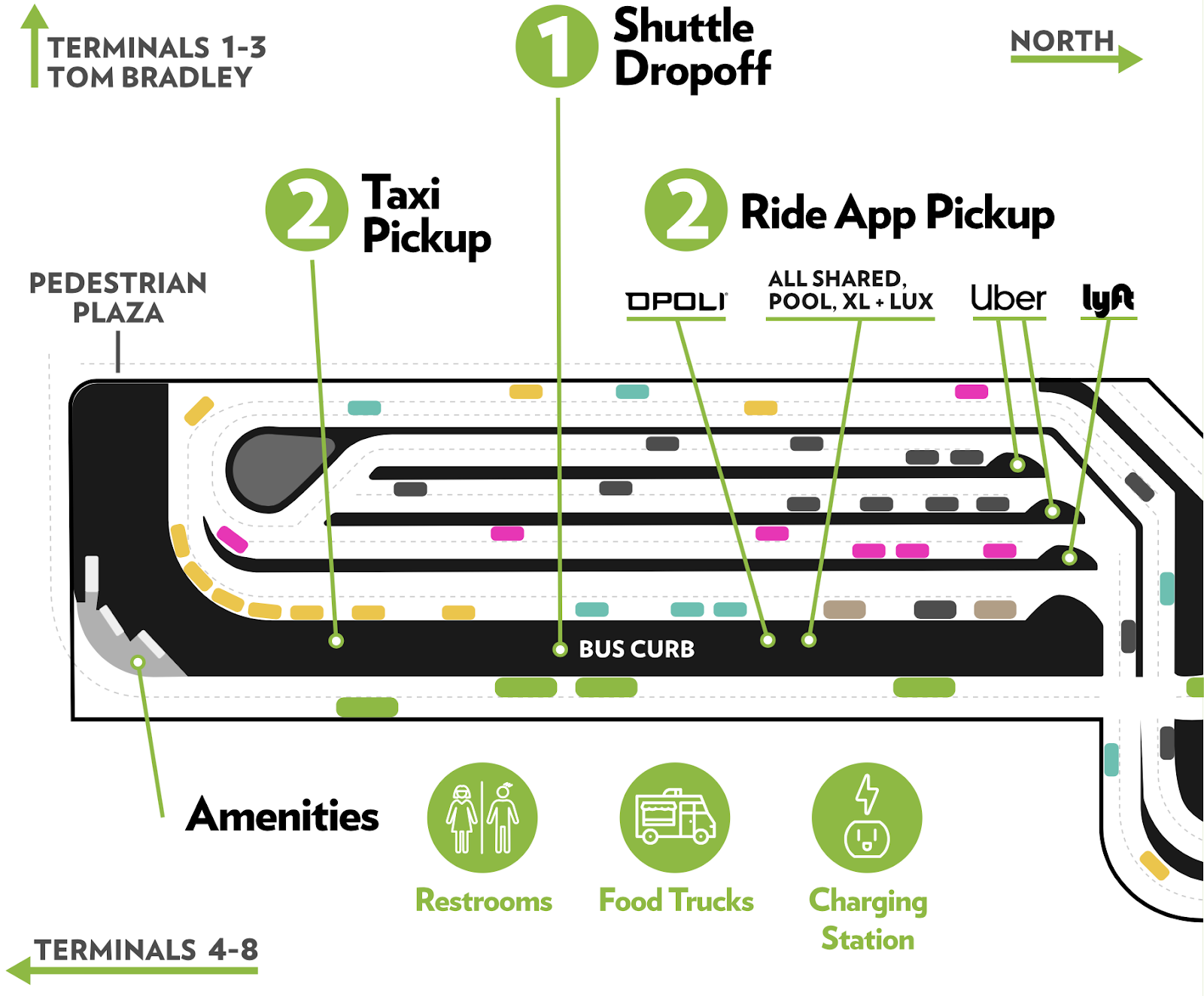
I thought I’d share my experience after summoning my first Uber ride from LAX-it. The first thing I had to do was find the shuttle that would take me from the terminal to the new Uber pickup point. Although Uber pickups were formerly on the departure (upper) level, the LAX-it shuttle is boarded from the arrivals (lower) level. Pickup points are shown in the following figure:


Depending on the terminal where you arrive, the shuttle may take up to 15 minutes to drive you to the Uber pickup point. According to the LAX-it website, it is about a 3-minute walk from Terminal 1 and an 8-minute walk from Terminals 7 and 8.

My next decision was when to summon my UberX ride. I arrived at Terminal 4 which is about a 10-mimute shuttle ride to LAX-it. Out of curiosity, I searched for available cars immediately upon boarding the shuttle, and the Uber app quoted me an UberX ride for $24. However, not knowing exactly when I’d arrive, I didn’t want to summon a car and keep the driver waiting so did not request the ride just yet. As the shuttle took me closer to LAX-it, I kept checking UberX fares, and I saw the prices increase to $30, $40, and eventually $50. I hypothesized that this was due to surge pricing as a result of a busload of passengers all requesting UberX rides at around the same time. I decided to wait until I knew exactly where I was going before officially requesting my UberX car.

After the shuttle dropped us off at LAX-it, there were plenty of signs that directed me to the UberX pickup area. Note that Uber Pool and Uber XL pickup points are in a different area. There are also separate designated areas for Lyft, taxis, and other ground transportation.


When I arrived at the UberX pickup area, I saw a short line, along with signage that provides travelers with instructions on how to request an UberX car. After you request UberX, instead of being paired with a specific UberX driver, you are provided with a 6-digit PIN. When you get to the front of the UberX line, you approach the next available UberX driver and provide your PIN. The UberX driver enters the PIN into his/her app, and that provides the driver with your destination.


My ride was priced at $45, almost double the fare that I was initially quoted. I wonder if it would have honored the initial $24 fare, despite me being more than 10 minutes away from my Uber driver. Next time I take UberX from LAX, I will try to request my PIN immediately after getting on the shuttle to see if it will let me lock in a rate while I am still en route to LAX-it. If you have any thoughts on the optimal time to request your UberX PIN, leave a comment below!

Sunday, November 17, 2019

I’m Not Working Out, I’m Just Walking

On most days, I walk my child to school and/or back home from school. On most days, my Apple Watch interrupts me to tell me this:


While I am able to mute the workout reminder for a day, does anyone know how I can mute the workout reminder permanently? According to Apple’s Work out with your Apple Watch support page, “To turn this setting on or off, open the Settings app on your Apple Watch, tap Workout, then go to Start Workout Reminder.” However, I don’t have a Workout option on my Apple Watch’s Settings app. Anyone know how to stop the madness?

Saturday, October 5, 2019

UFC: Undisputedly Fantastic Content

The UFC is not a fight company, it’s a production company—
one of the biggest in the world—that just happens to sell fights.

This is a quote from Into the Cage: The Rise of UFC Nation by Nick Gullo. As a mixed martial arts (MMA) fan who not only watches MMA fights but also follows matchmaking, fight preparation, fight promotion, weigh-ins, and post-fight press conferences, most of which is available on YouTube, this made complete sense to me. I’ve always been impressed with not just the depth of insider coverage of the UFC (which stands for “Ultimate Fighting Championship”), but also the quality of video production. A sampling of UFC programs that I regularly watch include (in no particular order):

  • UFC Countdown: summarizes the journey of the fighters leading up to UFC events
  • UFC Inside the Octagon: analysts profile fighter strengths, weaknesses, and fight strategy
  • UFC Embedded: an inside view of the lives of fighters in the days leading up to an event
  • UFC Connected: a detailed focus on UFC fighters and their lives in and out of the octagon
  • Dana White: Lookin’ for a Fight: Dana and his buddies watch local fight promotions; show production is in an adrenaline-pumping, profanity-laced travel vlog format
  • Dana White’s Contender Series: a fight card in between UFC events, with certain fighters on each episode awarded UFC contracts

There are also special video series such as UFC: 25 Years in Short. And let’s not forget The Ultimate Fighter reality TV series whose season 1 finale arguably saved the UFC from bankruptcy. Since I make home movies and have my own YouTube channel, I can appreciate the professional production quality of all UFC videos. The UFC really does invest a lot of effort in keeping its fan base engaged in its business 365 days a year, and a big part of that, at least from my experience, is through high quality video content. Recently I came across an article that provides insight into the UFC’s finances, and it provided the following chart:


Content production costs totaled a whopping 19.6% of all UFC expenses in 2015. The only larger expense category was fighter compensation (23.0%), and coming in third was employee compensation (11.3%). In other words, the UFC spends almost twice as much money producing content as it does paying its own employees. Note that there is a separate category for marketing costs (10.4%), exclusive of content production.

Elsewhere in the book, Nick Gullo summarizes a conversation with UFC President Dana White. Dana asserts that boxing promoters don’t invest in the sport because they simply coordinate and promote boxing matches, then take their money and run. Gullo writes:
On the flip side, the UFC “four walls” the event—which means they handle everything: broadcast production, ticket and merchandise sales, designing posters, you name it. The organization 24/7 promotes its fighters, pushes them in the UFC magazine and The Ultimate Fighter, features them on the UFC website, the television shows, video blogs, billboards. Drive down the highway, enter a grocery store, flip on the TV, wherever you turn it’s UFC Nation. And because they do everything and control everything, they deliver product that eclipses boxing.
I appreciate when my world view is challenged by a new perspective, and I agree that the UFC is a production company that happens to sell fights. I think this also supports Bill Gates’ assertion that content is king. While there are other MMA promotions such as Bellator, ONE Championship, Professional Fighters League, Titan Fighting Championships, Rizin Fighting Federation, and many others, the UFC is in a class of its own by any measure. I believe that its content production and its “four walls” approach has a lot to do with its success.

Even if you are not a fan of MMA, hopefully you’ll at least click on some of the links and appreciate the high quality UFC video content.