Showing posts with label Vaccine. Show all posts

Thursday, December 18, 2025

Autism and Vaccines - An Undead Conspiracy Theory

On November 19, 2025, the Centers For Disease Control and Prevention (CDC) updated its Autism and Vaccines website to state the following (click image to enlarge):

I’d like to take this opportunity to debunk the first 2 bullets in the Key Points section, as the information is just plain wrong, based on a preponderance of what the scientific community knows today.

The first bullet states “The claim "vaccines do not cause autism" is not an evidence-based claim because studies have not ruled out the possibility that infant vaccines cause autism.” I’ve worked in a health services research capacity with a focus on evidence-based medicine for 16 years, and I can say that this statement is misguided on at least 2 levels. First, the claim that “vaccines do not cause autism” IS in fact an evidence-based claim. The original study that suggested a causal link between vaccines and autism has been debunked. It was formally retracted and its lead author was found to have engaged in serious research misconduct, including falsification of data and undisclosed conflicts of interest. See this story for more information. Since then, there have been no credible well-conducted studies that demonstrate a link between vaccines and autism. Evidence-based guidance is founded on the principle that the preponderance of credible evidence favors a certain conclusion. Any knowledgeable and unbiased researcher would assert that the claim that “vaccines do not cause autism” is in fact evidence-based because a credible link between vaccines and autism has never been established despite countless studies that examine the benefits and side effects of vaccines.

The second part of the first bullet that is misguided is the statement that “studies have not ruled out the possibility that infant vaccines cause autism.” This is just plain illogical and a confusing and possibly devious use of words, to which it is not logical to draw any meaningful conclusions. You see, studies cannot not designed to “rule out the possibility that infant vaccines cause autism” because no such association has ever been observed. If I stated that “studies have not ruled out the possibility that pigs can fly” then it would be illogical to conclude the opposite argument that MAYBE pigs could fly, unless there was any credible observation that they could in fact fly. I believe that such a meaningless statement could only be made by someone who either has ulterior motives or beliefs that are not supported by science, or they are possibly made under duress.

Moving on to the second bullet point that “Studies supporting a link have been ignored by health authorities” is also misguided. The reason that health authorities ignore studies supporting a link between vaccines and autism is because there have been no credible scientific studies that support such a link. If I said that “studies supporting the possibility that pigs can fly have been ignored by the general public” then a rational person would say that those studies should be rightfully ignored because pigs have NEVER been witnessed to fly, based on credible evidence. So to imply that health authorities are sweeping an issue under the rug requires that there be a credible and rational reason to pay attention to the issue. In this case, there is no reason for health authorities to waste time on this issue. In my opinion, the only reasons we are even discussing it is because the general public does not have a sufficient understanding of the scientific process, and conspiracy theories arise from this lack of understanding.

Regarding the third bullet that “HHS has launched a comprehensive assessment of the causes of autism, including investigations on plausible biologic mechanisms and potential causal links,” I am supportive of such actions and can only hope that this research will be carried out responsibly and in accordance with the scientific method. I also assume that such a “comprehensive assessment” would result in data that are in agreement with the preponderance of previously established scientific information, and if so, then I hope that rational individuals would challenge their prior unsupported beliefs about a link between vaccines and autism. However, if HHS’ “comprehensive assessment” does not involve original credible research and they instead cherry-pick data from poorly conducted studies, then it will be obvious that HHS/CDC is driving a political agenda (as if it was not already clear). On the other hand, if there is novel credible research that is performed according to the scientific method that does in fact establish a link between vaccines and autism, then I will be eager to read that research, modify my perspective on this topic accordingly, and encourage additional studies to further corroborate such novel evidence.

In summary, the claims made by CDC are wrong and misguided based on a preponderance of the best available scientific information. At best, the claims represent a misunderstanding of science and evidence-based medicine. At worst, this is an example of misinformation by what was previously a well-respected federal agency. For additional reading on this topic, see the NPR article “The CDC revives debunked 'link' between childhood vaccines and autism” on 11/20/2025 and the Los Angeles County Department of Public Health’s “Statement on Updates to CDC Website on Vaccines and Autism” on 11/21/2025.

Saturday, November 27, 2021

COVID-19 Vaccination Record in Apple Wallet

I previously wrote about SafePass LA and briefly discussed why I prefer to store my COVID-19 vaccination record in Apple Wallet. In this post, I’d like to show you how you can get your COVID-19 vaccination record into Apple Wallet. There are 2 methods that I know of.

Method 1: Healthvana

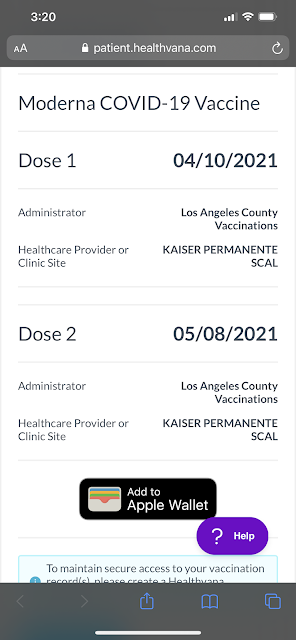
The Los Angeles County Department of Public Health partnered with Healthvana in December of 2020 to provide digital vaccination records as discussed here. A couple weeks after I received my 2nd Moderna COVID-19 vaccine, I received a text message from Healthvana. It contained a URL that allowed me to view a digital record of my vaccination:

After entering some information to confirm my identity, I was shown my COVID-19 vaccine record and presented with an option to add it to my Apple Wallet.

If you did not receive a text message or email from Healthvana, and if you received your COVID-19 vaccination in the county of Los Angeles, you can contact Healthvana and request your COVID-19 digital vaccination record. In the “What is your question about?” field, select “COVID-19 Vaccination” and complete the rest of the form. When I did this for my wife, she received a response later that same day.

Method 2: Vaccination QR Code

If you prefer not to use Healthvana, or if you did not receive your COVID-19 vaccination in the county of Los Angeles, there are other ways to get your COVID-19 vaccination record into Apple Wallet. All you need is a QR code of your vaccination record and an iPhone running iOS 15 or later (at the time of this writing, the current version is iOS 15.1.1).

Step 1 is to get a QR code of your vaccination record. There are at least 2 ways to get a QR code. The first is to retrieve it from your provider. For example, Kaiser Permanente has a portal where patients can login and retrieve immunization history and other parts of one’s medical record. This includes a QR code in SMART Health Card format.

If your provider does not provide a QR code to you, and if you live in the state of California, you can request your digital COVID-19 vaccine record at https://myvaccinerecord.cdph.ca.gov. Simply enter your name, date of birth, your phone number or email, and a 4-digit PIN (any 4 numbers that you want, for the purpose of securely accessing your digital record). After submitting this information, you should soon receive  a text message or email with a link to retrieve your COVID-19 vaccine record which will contain a QR code.

Step 2 is to scan your QR code with your iPhone running iOS 15 or later. Simply launch your camera app and point your rear-facing camera at the QR code. Once your phone recognizes the QR code, it will display a “Health” notification:

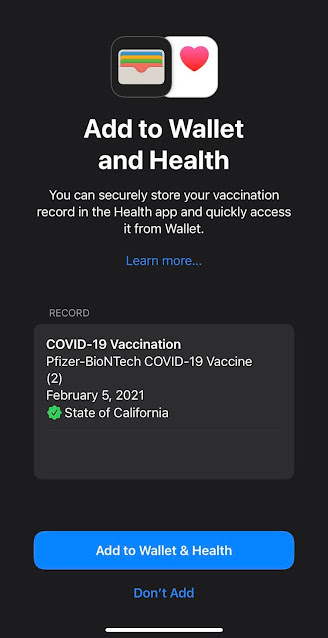
Tapping the “Health” notification will take you to the Apple Health app with a prompt to add your COVID-19 vaccination record to Wallet and Health. Here’s what it looked like when I did this for my wife:

Step-by-step instructions, along with other options to add verifiable COVID-19 vaccination information to Apple Wallet and Health, are provided here. Learn more about Apple Wallet here.

Tuesday, November 9, 2021

SafePassLA


If you live in or visit the county of Los Angeles, you should be aware of a vaccine verification program called SafePassLA which requires demonstration of proof of full COVID-19 vaccination for certain indoor locations and outdoor events. Examples of covered indoor locations include (but are not limited to):

  • Food & Beverage Establishments (e.g., restaurants, fast food establishments, coffee shops, cafeterias, food courts)
  • Gyms & Fitness Venues (e.g., yoga, dance studios, hotel gyms, any facility used for indoor fitness classes)
  • Entertainment & Recreation Venues (e.g., shopping centers, movie theaters, bowling alleys, sports arenas, convention centers, museums)
  • Personal Care Establishments (e.g., spas, hair/nail salons, barber shops)
  • Indoor City Facilities (e.g., city hall, senior centers, recreation centers)

Additionally, for outdoor event venues, events with 5,000 to 9,999 attendees will require proof of vaccination OR a negative COVID-19 test taken within 72 hours of entry.

SafePassLA launched yesterday (November 8, 2021) with a focus on outreach and education. Enforcement will begin November 29, 2021. I would not be surprised if enforcement will be spotty, especially with small business owners who may not have the staffing to provide such enforcement, but you should be prepared in case you are asked to show proof of COVID-19 vaccination. Whatever you do, don’t be this guy.

To demonstrate proof of COVID-19 vaccination, you can certainly carry your white Centers for Disease Control and Prevention (CDC) vaccination card with you, but there are other options that may be more convenient for you, especially if you carry your cell phone with you everywhere you go. One such option is to take a picture of your CDC vaccination card and store it on your phone. Another option is to use one of several mobile phone apps that provide digital vaccination records as listed here by the LA County Department of Public Health. Approved digital vaccination records are those made by Healthvana, Carbon Health, CommonPass, CLEAR Health Pass, and VaxYes.

I previously wrote about COVID-19 Digital Health Credentials, and I illustrated how you can add your Healthvana COVID-19 vaccination record to Apple Wallet. That will be my preferred method of showing proof of vaccination because it is convenient, and it will work even if I don’t have internet connectivity. As a backup, I already have my COVID-19 vaccination credentials loaded into CLEAR Health Pass, and I also have photo backups of my CDC vaccination card in Google Photos and as attachments in my personal email.

Sunday, June 20, 2021

California Digital COVID-19 Vaccine Record

I previously wrote about a variety of ways that my COVID-19 vaccination could be documented. Since then, the state of California has implemented its own Digital COVID-19 Vaccine Record. To access these vaccine credentials, simply fill out your name, birthday, and either the cell phone or email address that you used when you received your COVID-19 vaccine. Also set a 4-digit PIN that you’ll later be asked to re-enter to retrieve your credentials. From there, you will either receive an email or text message with a link that is valid for 24 hours. Here’s what mine looks like:


In the FAQ, it is emphasized that this digital record is not a vaccine passport. Rather, it states, “You are not required to obtain a digital COVID-19 vaccine record. It is an optional means to obtain your COVID-19 vaccine information, and is the digital version of your paper vaccine card. It is one of the options to show proof of vaccination. The State will not be implementing a mandatory passport system in California.”

In August, I will be attending a conference in which a conference-specific vaccine passport will be required for all attendees. Perhaps I will discuss vaccine passports as the date approaches.

Saturday, May 29, 2021

COVID-19 Digital Health Credentials

If you’ve received one of the COVID-19 vaccines, you might have realized that there are many ways to prove that you have been vaccinated. First there is the physical “COVID-19 Vaccination Record Card” with the logos from the U.S. Department of Health and Human Services and Centers for Disease Control at the upper right. Here’s mine:

If you received your shot at a location where you normally receive healthcare, you might also be able to access your immunization records through a patient portal. Here’s what mine looks like from a desktop-based web browser. Note that it unfortunately does not list the dates, and there was a data entry error because for my second shot, I asked that it be injected into my RIGHT arm.

In some cases, your local city or county may have partnered with a 3rd party health information technology company to provide you with a digital version of your vaccination record that can be added to a mobile wallet. Los Angeles County has partnered with Healthvana on this effort, and I received a text message that my vaccination record was available to be added to my mobile wallet. Here are screenshots from my iPhone to illustrate what it looks like to retrieve my vaccine information from a mobile web browser and what the record looks like in Apple Wallet:


As if there weren’t enough options, if you have an iPhone and a healthcare provider that supports interoperable patient data through a “Blue Button” download, you could transfer your vaccination information and other health records to your Apple Health app. Follow these instructions to add your health data to Apple Health. Here’s what my immunization record looks like in Apple Health, both in human-readable summary view as well as the underlying data:


There is much discussion about vaccine passports nowadays which has given rise to many questions. Can we do it? Should we do it? Is it even legal? Without getting into a lengthy debate, suffice it to say that technologies have already been around for many years, and we’ve already been implementing digital health credentials to varying degrees for quite some time. For me, adding data related to COVID-19 vaccination simply represents a more comprehensive picture of my overall health data.

In addition to the discussion about vaccine credentials or passports, perhaps a bigger challenge is to figure out whether we can all agree on a common method to share health data. There is a saying that goes something like this: “The great thing about health IT standards is that there are so many of them to choose from.”

Friday, March 12, 2021

When Eligible, Find Your COVID-19 Vaccine

The United States is gradually increasing its supplies of COVID-19 vaccines, and most Americans are still waiting for their turns to receive one of them. I previously wrote about how Californians can sign up to be notified when they become eligible for a vaccine.

However, state health department recommendations and vaccine rollout plans may vary, so if you don’t live in California, you can visit a CDC website to be redirected to your state health department’s website to find out your eligibility. Simply select your state or territory and then follow the guidance provided by your state.


When you do become eligible, you might need to find out where you can get vaccinated. The CDC, in partnership with Boston Children’s Hospital, Harvard Medical School, and Castlight Health, have launched VaccineFinder to make it simpler for you to find a location near you where you can get vaccinated. The website reminds visitors that appointments are required at most locations.

For more information about COVID-19 vaccination, check out the CDC’s Frequently Asked Questions about COVID-19 Vaccination.

Monday, February 15, 2021

COVID-19 Vaccination: How is California Doing?


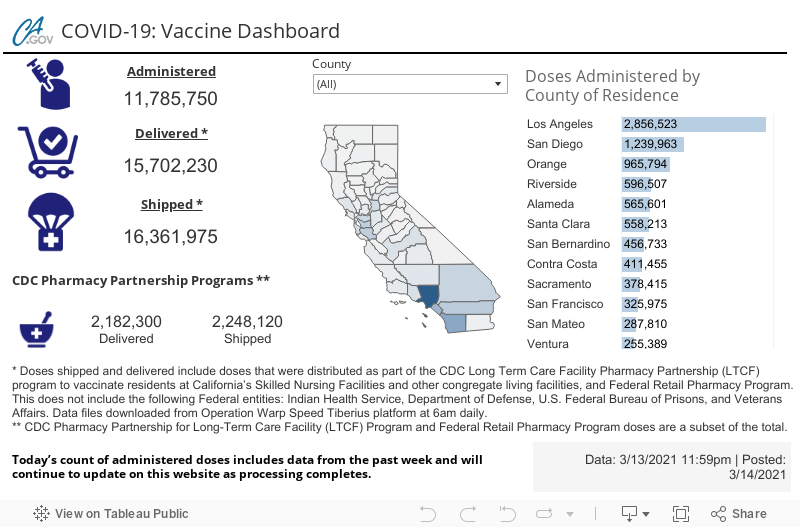
It is well-known that there are numerous logistical issues related to the manufacturing and equitable distribution of COVID-19 vaccines. That being said, the vaccines are slowly but surely making their way into all 58 counties in California. The official website for California Coronavirus Response provides many resources, including a COVID-19 state dashboard where cases, deaths, tests, and vaccine administration are shown in dashboard views. While many of us are quite familiar with dashboards for the daily and total cases, deaths, and tests, the  California COVID-19 Vaccine Dashboard is a relatively new addition to these data visualizations.

The vaccine administration dashboard is simple in nature. It displays the quantity of vaccine that has been shipped, delivered, and administered throughout all 58 counties in California. As depicted above, the CDC Pharmacy Partnership for Long-Term Care Program and CDC Federal Retail Pharmacy Program doses are a subset of the total. A live and interactive view of the dashboard is available here:

COVID-19 Vaccination: Is It My Turn?


As soon as the first COVID-19 vaccine was approved in December 2020, the state of California launched its “Vaccinate All 58” campaign with the aim of providing vaccinations for residents of all 58 California counties in a safe and equitable manner.

According to the campaign, “vaccines will be administered in phases by prioritizing groups according to risk and level of exposure. Initial doses will go to California’s essential health care workers and those among our most vulnerable in long-term care settings.” For more details, see the vaccine distribution plan and the Phase 1A vaccine distribution recommendations at the California Department of Public Health website.

While this background information may be interesting and useful to some, if you’re one of millions of Californians who are wondering when it will be your turn to get vaccinated, check out My Turn. According to the site, “Find out if it’s your turn by answering a few questions. It only takes a few minutes. If you’re eligible and vaccine appointments are available through My Turn, you can schedule one. If it’s not your turn yet or appointments are not available, you can register to be notified when you’re eligible or when appointments open up.”


I am not yet eligible for a COVID-19 vaccine, but I registered to be notified and will gladly schedule an appointment for the COVID-19 vaccine as soon as supplies become available for my demographic.

Saturday, September 26, 2020

Influenza Viruses and Vaccines: What’s in a Name?

Yesterday our family got our annual flu shots. Since influenza virus constantly mutates, the influenza virus vaccine varies from year to year. Scientists try to predict which strains of influenza virus will result in the greatest number of cases, and they create vaccines to target those strains.

Out of curiosity, I usually ask the nurse to give me a copy of the package insert. Also referred to as a “drug label” or “FDA label” or other names, the package insert is the document that is created by the drug manufacturer and describes indications, contraindications, dosing, side effects, and other information relevant to the drug. Sometimes nurses refuse to give me the package insert, sometimes they make up excuses (e.g., “We don’t have it”), and sometimes they gladly give me a copy. Yesterday I was given a copy of the package insert for the 2020/2021 influenza virus vaccine:


As you can see, this package insert is quite lengthy, as are most package inserts. And as you could guess, most people don’t read them. But I am not like most people—I do uncommon things like write blog posts (that most people don’t read).

In any case, the reason for my interest in reading the package insert is to find out which strains of influenza virus the vaccine is designed to combat this year. For the 2020-2021 flu season, we are targeting the following 4 influenza virus strains (2 A strains and 2 B strains):

  • A/Guangdong-Maonan/SWL1536/2019 (H1N1) CNIC-1909
  • A/Hong Kong/2671/2019 (H3N2) NIB-121
  • B/Washington/02/2019 (B-Victoria lineage)
  • B/Phuket/3073/2013 (B-Yamagata lineage)

I’ll try to explain some of the nomenclature. The “A” and “B” refer to one of the 4 types of influenza virus. Influenza virus A and B viruses are the most common causes of seasonal influenza in humans, and some strains are included in the vaccine as described above. Influenza virus A (but not B) can cause flu pandemics, depending on viral characteristics. Influenza virus C also causes flu in humans, but illnesses are generally mild. Influenza virus D infects cattle but is not thought to cause human illnesses.

Influenza A viruses have 2 surface proteins that are important to characterize: hemagglutinin (H) and neuraminidase (N). There are 18 H subtypes (H1 to H18) and 11 N subtypes (N1 to N11), yielding 198 permutations of H and N proteins, of which 131 combinations have been found in nature.

Influenza B viruses also have H and N surface proteins, but for classification purposes, they are subdivided into one of 2 antigenically distinct lineages: Victoria and Yamagata.

Both influenza A and B viruses can be further subdivided into clades (groups) and sub-clades (sub-groups) based on the genetic codes behind the H surface proteins, and this sub-classification allows us to track which specific viruses are in circulation.

As you can see from the names of the virus strains, there are city names that indicate where the virus was isolate, and there are numbers that indicate the strain of the virus and the year they were isolated. For more information about the nomenclature of influenza viruses, check out this memorandum from the World Health Organization, and click on the free full text link if you want to see a PDF version of the full memorandum.

Because the H1N1 and H3N2 strains of influenza virus A are prevalent, the influenza virus vaccine usually contains antigens that resemble their structures. The vaccine also contains one or two influenza B virus antigens. I hope this sheds some light on what’s in this year’s flu vaccine.

In my next post, I’ll continue this discussion by focusing on the package insert of the influenza virus vaccine.